Sunday, 29 March 2015

Why is this time so special? (Part 1)

Around this time of the year, the worldwide Body of Christ recognizes a very significant historical event—the death, burial and resurrection of Jesus Christ. Most of us know it as “Easter,” but the biblical name for it is “The Lord’s Passover.” This particular feast began as a time to commemorate the deliverance and exodus of the children of Israel from Egypt. The first Passover is described in Exodus 12. One lamb was slain for every Israelite household, and the blood was painted onto their doorframes. The motion they used when applying the blood to the doorframes replicated the Hebrew letter meaning “life.” This was done so the Lord would not kill the firstborn son of the Jewish households, but only those of Pharaoh and his people. Exodus 12:13b says, “…And when I see the blood, I will pass over you…” Prior to their departure from Egypt, they were to quickly eat the lamb with unleavened bread and bitter herbs.

While studying covenant, I discovered there couldn’t be a covenant without the shedding of blood. Therefore, what makes the Lord’s Passover so important is the blood of the Lamb of God! You may be wondering if Passover and Easter are the same? No, they are not. Church history explains that when the Emperor Constantine tried to merge Christianity with Paganism, it sounded great to followers of
Jesus because he was legalizing Christianity. This meant one could go to church without fear of being thrown to the lions. Constantine didn’t mind Christians celebrating Jesus’ resurrection, but he did mind them observing the Passover. He demanded that Christians not celebrate Jesus’ resurrection at the time of the Passover. He outlawed this feast and declared Christ’s death and resurrection to be celebrated on the Sunday following the first full moon, after the vernal equinox. This is the spring festival of the pagan fertility goddess, Ishtar, also known as Eastre. Most of the church still observes Jesus’ resurrection at Easter, instead of Passover. Those who celebrated the Passover were brutally murdered. Satan has tried to stop its celebration, because it is centred on the blood of the Lamb of God, and he knows the blood has power and covers all sin.

During my treasure hunt, it was astounding to discover that the timetable of the Passover and the timetable of Jesus’ crucifixion were exactly the same. According to the Torah (first five books of the Bible), during the Passover, a number of events had to take place in a specific order and at specific times:

1. The Passover Lamb had to be selected on a specific day. God instructed the Israelites to choose the Passover lamb on the tenth day of the first month, which in the Jewish calendar is in the spring. At the time of Jesus, only lambs born and raised in Bethlehem were considered eligible to serve as Passover lambs. After their birth they were wrapped in a cloth. When Jesus was born in Bethlehem the sign the angels told the shepherds to look for was a baby wrapped in swaddling cloths, lying in a manger. Why would this be the sign to the shepherds? Because for Jews swaddling cloths were only used to wrap a dead body. It was the custom for travellers to take a swaddling cloth or strips of cloth on their journey, so if they died on the way, whoever found them could easily wrap the body in the cloth, and then bury them. Joseph and Mary most likely travelled to Bethlehem with such a cloth. Without them realizing it, and probably having nothing else soft, or suitable to wrap newly born Jesus, they used the swaddling cloth. So right at birth, Jesus was set apart for death. The priest would select a lamb from Bethlehem that would be without blemish and four days before the Passover he would bring it through the Eastern Gate of the city of Jerusalem, where the temple was located. The people knew to gather at the Eastern Gate to see which lamb he had selected. When it was Jesus’ time to die as the Passover Lamb, what gate did He come through riding on a donkey?The Eastern Gate, where the people had already assembled. Palm branches were waved and the people received Him as their Messiah. Prophetically, they were choosing Him as their Passover Lamb.


There are more treasures that I will share in the next blog.

(Taken from “The Treasure Within” book written by Kathy Gooch)

Saturday, 14 March 2015

Life out of devastation

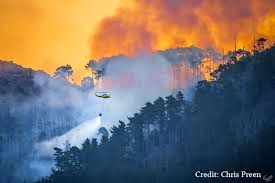
The mountain behind where I live on fire

It’s one thing to see a wildfire on television but it’s quite another to witness it sweep across the mountainside right above you. I live below one of the beautiful Table Mountain ranges in Cape Town. They have always wowed and impressed me like nothing else I have seen in all my travels. There is something to be said about their prominence, majesty, magnificence, beauty, strength and even mystery especially when you’re hiking them and think you’ve reached the top, only to discover there is another top! While their awesomeness seems to command my respect, at the same time they invite me to get up close and personal. And wrap me in their arms once I do. The sun is always brighter at the top and the sky bluer and the air fresher and the sounds clearer. There is no end to what one can discover on those mountains. They constantly challenge you to go up higher and not miss out on what could be just around the corner. Clothed from top to bottom with flora (or fynbos as its called here) and teeming with fauna; they are a picture of vitality.

Not once in all the years I have looked upon or walked upon these mountains would I have used the word vulnerable to describe them. But after witnessing the raging fires, that over five days devastated 5000 hectares of vegetation, I would add the word vulnerable to my description of them. Yes, the mountain itself is still standing but what decorated it has been stripped away. It’s naked, exposed. No longer a hiker or photographer’s paradise.

My mountain on fire

At this point it may be helpful for us to know the definition of vulnerable – able to be wounded. It is basically placing yourself, for the sake of the larger purpose, in a situation that could bring pain. For me the fires and how they have affected these mountains have been such a picture of the nature and character of God. Here He is prominent, majestic, magnificent, and mysterious and we could add to these hundreds of words; yet He has allowed Himself to be vulnerable. Much like these mountains succumbing to the whims of humankind who carelessly light fires during dry summers, God voluntarily places Himself in a situation that could possibly bring Him pain. It isn’t that He doesn’t foresee the implications of our carelessness, but because He has given us freedom of choice, He subjects Himself to our choices. Philip Yancey, one of my favourite Christian authors writes in his book, Reaching for the Invisible God, “I marvel at a God who puts Himself at our mercy, as it were, allowing Himself to be quenched and grieved, and even forgotten.” For me, the amazingness (if there is such a word) of God is that He goes through quenching and grieving while continuing to have His arms opened wide anticipating our turning back to Him. Not only that, but once we do, He turns all the heartache, pain, and damage we’ve done and redeems it.


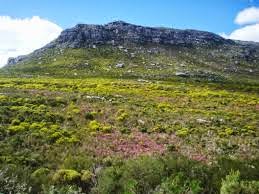
My friend who works for Table Mountain National Parks sent me an article that helped to alleviate my distress at the effects of the fire. The botanist who wrote the article says that the fynbos vegetation that clothes our mountains is both fire prone and fire dependent. In order for the plants in the fynbos to be able to regenerate or reproduce it needs to be subjected to fire (usually controlled fires) every 10-14 years. The article says that these plants either resprout after a fire or they produce seeds that are adapted to survive fire and require heat and chemical compounds from the smoke to germinate. Some plants would have spread their seed within hours after the fire passed. So this magnificent mountain, in time, will be clothed even more brilliantly than before.

I don’t believe that the choices we make in any way diminish who God is. He remains the same yesterday, today and forever. But I do stand amazed that despite what we do to Him, He chooses to bring life out of devastation. 


Before fire
After fire
        
Before fire

After fire

Saturday, 14 February 2015

For Love's Sake

Most of us have grown up knowing how to celebrate Valentine’s Day, but do we know why we are celebrating it? One of my favourite sayings that has changed the way I look at life is, “Those who know why have the advantage over those who know how.” I’ll be the first to confess that I have been an ignorant bystander as to why February 14th has been set apart. Honestly speaking, the only reason I decided to investigate further is because I thought I probably wasn’t the only ignorant one and it might be a good idea to write a blog about it. Huh! Don’t you wish we all had a reason to dig a little deeper?

Well in some ways I have not come away disappointed and in other ways I have. To begin with let me share why I’m not disappointed. According to history there really was a St. Valentine or more accurately, Valentinus. He lived during the reign of the Roman emperor Claudius II. Now according to what I read, historians aren’t sure if either or both of what I’m about to share are true. Claudius II had this belief that single men made better soldiers as their loyalty would not be divided between their country and their wives and children. Hence, he outlawed marriage. Valentinus was a priest and decided to officiate marriages in secret. The emperor had a pantheon of gods that he decreed were to be worshipped and it was a crime to speak to Christians. Being a believer in Christ, Valentinus, refused to worship these gods. So whether Valentinus was found guilty of one of these or both, we are not sure, but he was caught, arrested, imprisoned and sentenced to death.

The jailer who guarded Valentinus found him to be a very intelligent, kind and giving man. Having a daughter who was blind the jailer asked Valentinus if he would teach his daughter, Julia. Julia came to the prison and learned from Valentinus academics and the ways of God. The two became close; Valentinus seeing Julia like a daughter and Julia seeing Valentinus as a friend and mentor. She confided in him that her one desire and constant prayer was to receive her sight. Again, we’re not sure which one of the following is true, but one account says that a flash of light filled the room and Julia received her sight and another says that Valentinus prayed for her and she was healed. Valentinus was scheduled to be executed on February 14th, 270 AD. Right before his execution, he wrote a note to Julia and signed it, “From your Valentine.”

Wow! What a beautiful story of Valentinus’ willingness to be martyred for love’s sake. I suppose my disappointment comes when the power of the meaning of this day has been diluted down to chocolates, flowers and romantic (or rotic – romantic without the man) dinners. Not that there is anything wrong with these expressions, but if that is all there is to Valentine’s Day then I believe we have missed out on its true message. I have just returned from spending Valentine’s evening visiting the sick in the largest hospitals in Cape Town, along with around 20 University students. It was their idea to spend Valentine’s evening taking the love of Christ to the patients by listening to their stories, giving out flowers and sweets, and praying for their healing. Personally, I can’t think of a better way to celebrate this day, especially now that I know why it has been set apart. If we dig a little deeper, we will find that there is a lot we can do for love’s sake.


Wednesday, 28 January 2015

Love Covers

He spoke. They disobeyed. He looked for. They were naked. He called out. They hid. He confronted. They blamed. He covered.

Love Himself covered those He had created with garments made from the skin of an animal He killed. Despite the fact they had sinned against Him and grieved His heart, Love reached out and covered.

During my “Following in the footsteps of Paul tour” in Greece and Turkey, we were taken to the ancient city of Corinth. 
Many scholars believe that Paul wrote four letters to the Corinthians, but our Bibles only contain letters two and four. In Paul’s day, Corinth was a strategic, wealthy, commercial port of the Roman colony. Here he planted a church with the help of Aquila and Priscilla. The Jewish religious leaders had rejected him so he carried on with the Gentiles. As a port city, Corinth was renown for its constant  exposure to all kinds of people, ideas, and morals. In fact, to “Corinthianize” meant the participation in drunkenness and immoral sexual practices. Needless to say, Paul had his hands full! 


Five centuries before Paul’s arrival, on the 2000-foot (609 metres) summit of the Acrocorinth, there was a temple dedicated to the worship of Aphrodite. She was the Greek goddess of love, beauty, pleasure and procreation, and her Roman equivalent was the goddess Venus. Here 1000 temple prostitutes performed their duties. 
Ruins of Temple to the worship of Aphrodite

Acrocorinth

Although the temple was in ruins long before Paul came to the city, its spirit lived on in the prostitutes who roamed the streets looking for clients. As our tour group stood in the ruins of that ancient city, our Greek Christian tour guide pointed us to some Bible passages that Paul wrote in his letter to the Corinthians. In some cases, he was even able to show us what Paul would have been referring to in those passages. One passage our guide referred to was about head coverings. 

What our guide understood about this passage was that prostitutes in Paul’s day had uncovered, shaved heads to distinguish them from other women who wore head coverings in public, as was the norm in those days. Their uncovered, shaved heads would ensure that especially the foreigners coming to the city would know whom to approach. When prostitutes came into a saving knowledge of Christ, their hair would take a long time to grow. In order for these women not to stand out from the other women in the church, Paul said all should wear head coverings. The tour guide suggested this was Paul’s way of protecting these ex-prostitutes from being ostracized; likewise, his way of protecting the reputation of the married women. No matter their background, they were all to be viewed as equal, which they were in God’s eyes.

I in no way consider myself a theologian or a Bible scholar. Thus, I will avoid delving into an exegesis of this passage. What I do love to discover, and encourage others to discover, is the heart of the Word. For me hearing this description was refreshing. It revealed the heart of Paul who knew firsthand that “Love covers all sins” (Proverbs 10:12; 1 Peter 4:8). 


From my perspective, the heart of this passage isn’t whether women should or shouldn’t wear head coverings in church today; it’s about looking into our own hearts to see whether we are proponents of our heavenly Father’s “Love covers” campaign or not?

Tuesday, 13 January 2015

In a mirror, dimly

Have you ever wondered why a word or prophecy that you were given has not come to pass as you expected? I have. Now that I am a lot more keen on learning God’s ways, and not wanting my own way, I have a partial, but not complete, understanding of why. Towards the end of Paul’s chapter in 1 Corinthians on love, he writes, 

“For we know in part and we prophesy in part. But when that which is perfect has come, then that which is in part will be done away. When I was a child, I spoke as a child, I understood as a child, I thought as a child; but when I became a man, I put away childish things. For now we see in a mirror, dimly, but then face to face. Now I know in part, but then I shall know just as I also am known.”

Paul likens how we see knowledge and prophecy as looking in a mirror, dimly. Now to our 21st Century minds this concept of a mirror doesn’t make sense. For us a mirror is far from dim! It is either our friend or foe because it reflects such a brutally honest image of how we look. Without our mirrors how would we know we have grey hairs sprouting, or a pimple protruding, or a piece of spinach stuck in-between our teeth? Unless, of course, we have a brutally honest friend or spouse! 

Ancient mirror made of polished bronze
On the contrary, the 1st Century mirror Paul was referring to was made of polished bronze or metal. Our Greek tour guide pointed to such a mirror in a display case referring to this verse in 
1 Corinthians. Indeed, one would only see their reflection in part. Thus, the imperfect or dim view of themselves in the mirror, Paul compared to our imperfect understanding of knowledge and prophecy here on earth. 


It was the end of 2006 when I sensed the Lord saying I would be leaving Zimbabwe where I had been serving as a missionary since 1999. A treasure hunt to discover where He was sending me and what I would be doing ensued. As I prayed, fasted, studied His Word and sought counsel from those I trusted, I received small clues along the way. I don’t know if you are like me, but I eagerly turned the clues into conclusions, and started imagining and planning the next step. I quickly learned during this transitional time of seeking that God doesn’t like to be put in a box—He likes room to move and expand. The prophetic words and dreams I received during this time were meant for His interpretation and fulfilment, not mine. They were going to unfold and be completed in the time He desired (I moved to Cape Town in 2009); much like a baby developing in a womb and waiting for the appointed time of delivery. If God fulfilled the word immediately it would be deformed, incomplete, much like the development of a new life. It cannot be born at the moment of conception. It needs a safe, protected womb or environment for it to develop, and it will only be released when it is ready to breathe through its own lungs. I realized later that in many ways my prayers and fasting were attempts to twist God’s arm to move in the way I thought He wanted. I also realized He wanted to be the Treasure I discovered, not the clues along the way.

The more I discover God’s ways, the more I realize He isn’t interested in microwave results, but rather, that of a slow cooker. That way the flavours are more pronounced because they took their time to simmer. It is in our times of simmering that God produces something beautiful in us, and eventually through us. During our time here on earth, which is but a blink of the eye in relation to eternity, we will only see and know in part. It is only when we meet our Saviour and Lord face to face will we see and know perfectly why things had to be the way they were. In the meantime, may we put our trust in the One who sees and knows perfectly, clearly and lovingly.

Tuesday, 30 December 2014

Going into the New Year naked!

As written in my last blog I recently had the privilege of following some of the Apostle Paul’s footsteps in Greece and Turkey. What were especially meaningful to me were the occasions our Greek Christian tour guide related the uncommon things we were seeing to what Paul and the ancient Greeks would have known as common. For instance, whether we were in museums or walking through ancient Greek or Turkish cities, we encountered statues of naked people. Why? The culture of the day believed the human form was the measure of all things, both beauty and the divine. The perfect body was the athletic body and athletes competed naked. 


In the first few verses of Hebrews chapter 12, the author (possibly Paul) makes a parallel between athletics and our Christian life. 

“Therefore we also, since we are surrounded by so great a cloud of witnesses, let us lay aside every weight, and the sin which so easily ensnares us, and let us run with endurance 
the race that is set before us…”

The readers of the day would have quickly understood the comparison. We, however, wouldn’t. When we have the backdrop of what is being described it surely gives us an appreciation for what we also are being challenged to do. 

To the Greeks, a cloud was a literary term used for a group of people. In this case, it was those people witnessing the athletes competing in a race. Laying aside every weight, in its literal sense, was referring to the body fat of the athlete or the weights that they trained with on their arms and legs; all of which they were to get rid of when competing. What would potentially ensnare, entangle or cause them to trip were their robes, which they took off, running naked and free from all these encumbrances.
Endurance would be required for the race they were running. The Greek word for “race” is an athletic term meaning “agony” in English. Somehow the words “endurance” and “agony” would more duly fit the marathon race and not the 100-metre!
Panathenaic Stadium in Athens.
Hosted the first modern Olympic Games in 1896.
Reconstructed from the remains of an ancient Greek stadium.
Built entirely by marble.
So this is the picture the author of Hebrews was painting for the readers then, and now for us. The cloud of witnesses are those referred to in the “Hall of Faith” in Hebrews 11. These men and women remained faithful, albeit making imperfect progress, in the race set before them. We are to follow their example and remove unnecessary excesses or weights in our lives, taking off those sins that will end up entangling, encumbering, and ensnaring us, as we endeavour to run the race that has been prepared for each one of us. It means getting rid of everything the world tells us to hang onto – the lust of the flesh, the lust of the eyes, and the pride of life (1 John 2:16). It also means not giving up. After 43 years of running this race, I can assure you it requires endurance. I remember the Lord saying to me quite a few years ago that He wasn’t training me to be a sprinter, but rather, a marathon runner.  

The writer of Hebrews goes on to point the runners of this race to their ultimate goal…

 “looking unto Jesus, the author and finisher of our faith, who for the joy that was set before Him endured the cross, despising the shame, 
and has sat down at the right hand of the 
throne of God.”

He’s the One who started the race, ran it and finished it. All the while in an attitude of vulnerability, humility, openness – nothing to hide – naked! Perhaps as we end 2014 and head into 2015, we need to stop long enough and ask Holy Spirit to show us what weights, encumbrances – sins - we are still carrying that are keeping us from running our race of faith with fleetness and strength. Then laying them aside… Let’s go into this New Year naked!


Thursday, 11 December 2014

"Don't leave home without it" (Part 2)

I recently had the privilege of joining a Christian tour group as we endeavoured, in 10 days, to follow some of the Apostle Paul’s footsteps in Greece and Turkey. This was a belated 50th Jubilee Birthday trip for me. The tour proved to be both packed full of sights and availed impactful insights into the historical and biblical significance of places like Athens, Corinth, Patmos, Ephesus, Crete, Berea, Thessaloniki, Philippi. An amazing God-incidence was that we happened to be in Berea, Greece when I celebrated my 51st Birthday. Because of my love for the Word and study of it, I couldn’t imagine being in a more meaningful place on that special day. 

Ancient Ruins at Thessaloniki


Jewish synagogue in Berea

In case your memory isn’t serving you so well, I’ll give you some background on the significance of Berea as found in Acts 17. Paul and Silas were in Thessalonica and after leading many Greeks to the truth of Jesus; some jealous Jews gathered a mob to accuse them of turning the world upside down. However, they couldn’t find Paul and Silas to bring them before the rulers of the city. The two men of God escaped that night and made their way to Berea. There they found in the synagogue Jews who were more open than those in Thessalonica. In fact, “…they received the message with great eagerness and examined the Scriptures every day to see if what Paul said was true.” 

Plaques in Berea commemorating the Bereans
The Bereans were lovers of the truth and definitely didn’t leave home without it. We may think that back in those days it was easier to discover and know the truth, but not so. From our tour we learned that Greece was inundated with philosophies, gods and goddesses, and the worship thereof. In Athens, the common phrase one would use when approaching a friend or stranger was, “What’s news?” According to Acts 17:21, “For all Athenians and the foreigners who were there spent their time in nothing else but either to tell or to hear some new thing.” We could say truth was relative. That’s one of the reasons why Paul’s assignment to preach the truth that Jesus Christ was the only way to the Father was met with such opposition. It wasn’t until people met and acknowledged the Truth that they were set free.

From my observations, our 21st Century post-modern thinking hasn’t proven to be much different to the philosophies of Paul’s day. In many ways, we’re still asking, “What’s news?” desperately wanting to latch onto the newest and latest craze. This pervasive way of thinking has even seeped into the body of Christ where experience supersedes reason, subjectivity supersedes objectivity, images supersedes words, and outward supersedes inward. When one values experience more than reason then truth becomes relative. In other words, up to the individual. And if it’s up to the individual’s experience to decide what is the truth then this negates the Bible being the source of absolute truth. It becomes up to the individual to define and interpret truth – it can be this one day, and that another day. 

For us not to have an immovable, undeniable source of truth is like throwing us to the lions – we will be devoured! We truly need to go back to the way of the Bereans measuring every new teaching, every new thought against the God-breathed Scripture, as Paul so aptly described it to Timothy. 


Statue of Paul in Berea
When Jesus was brought before Pilate He was asked if He was a king. Jesus replied that Pilate was accurate in his description and that He had indeed come into the world to bear witness to the truth. Jesus goes onto promise that everyone who is of the truth will hear His voice. Perhaps this is a good litmus test for us all. Do we hear Jesus’, the Word’s, voice in what we are listening to, or reading? If we aren’t, then it isn’t the truth. Someone’s voice will end up being stronger – our own, the world’s, the enemy’s, or God’s. In Paul’s description of the Word to Timothy, he was highlighting that God’s voice will only be stronger if we take time to allow His Word to teach, rebuke, correct and train us in righteousness so that we may be thoroughly equipped for every good work (2 Timothy 3:16, 17).

In essence what Paul was saying to Timothy was, “Don’t leave home without it!